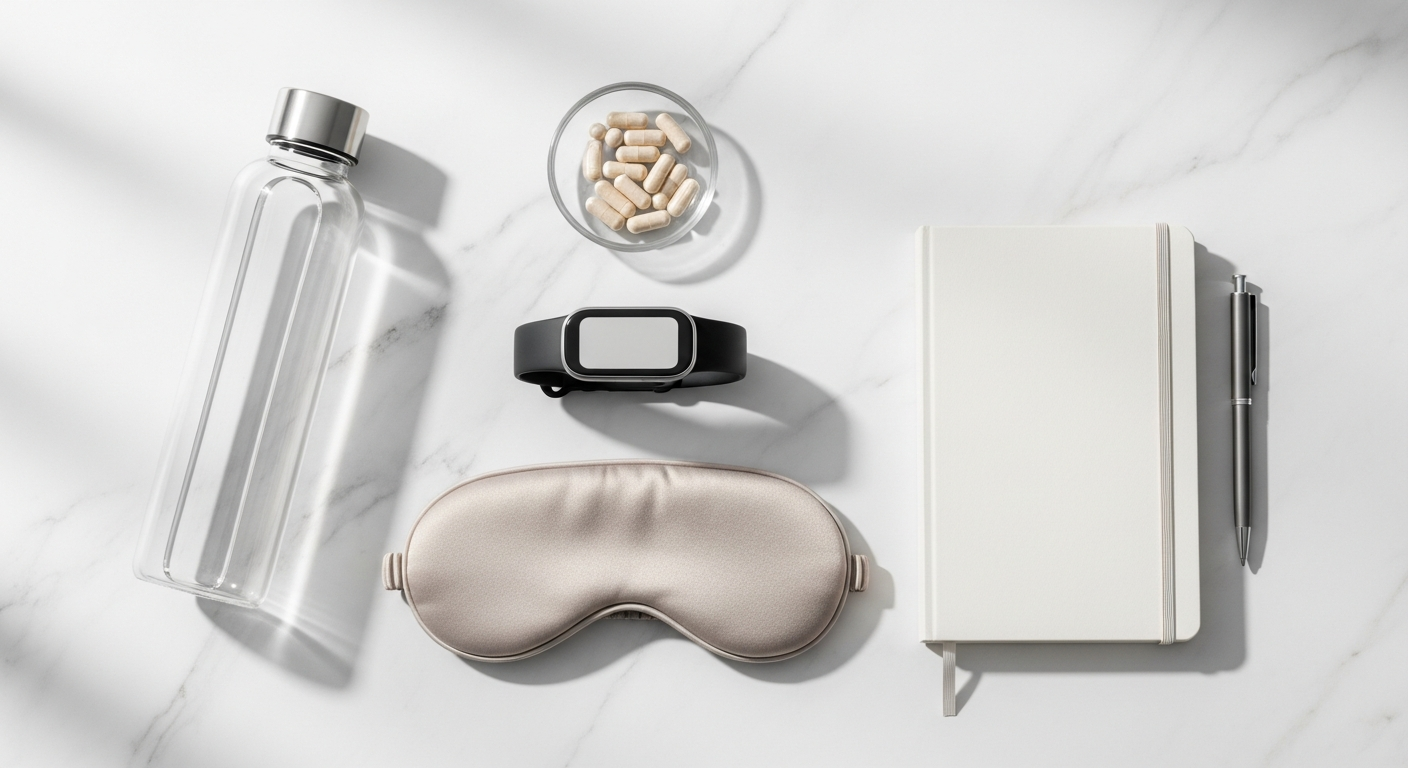
There’s no shortage of biohacking content. Or biohacking products. Most of it is hype dressed in scientific language.
Here’s what actually works — and what I’d skip after a year of data-driven self-experimentation.
The Honest Truth About Biohacking
The most popular biohacking tools deliver little if the fundamentals are broken. Before spending thousands on infrared saunas, peptides, or NMN supplements, these are the levers with the highest ROI:
- Consistent sleep (same timing, 7–9 hours)
- Daily movement (even just 30 minutes of walking)
- Unprocessed food (no rocket science needed)
- Reduce alcohol (HRV killer #1)
- Stress management (real, not Instagram-worthy)
If these five aren’t working, no gadget changes your performance. Seriously.
Fundamentals first, optimization second. In that order.
The Real Starter Kit (5 Tools)
Tool 1: Sleep Tracking Wearable (~€300–350/year)
Why first: Sleep is the foundation. Without solid sleep data, you don’t know what you’re optimizing.
My choice: Whoop 4.0
- Recovery Score every morning (HRV, RHR, sleep stages)
- Forces honesty about recovery
- Cost: from $239/year (device included)
Alternative: Oura Ring Gen 3
- Excellent sleep tracking
- Discreet ring form factor
- Smaller subscription ($6/month)
- Cost: €349 + €6/month
What you’ll learn: How alcohol, food timing, sleep schedule, and training affect your recovery. Sounds obvious — turns out to be transformative.
Tool 2: Continuous Glucose Monitor (€65 for 14 days)
Why: Blood sugar affects energy, focus, sleep, and body weight — even without diabetes. Almost nobody knows how their body responds to the food they eat.
My choice: FreeStyle Libre 3
- Automatic reading every minute
- No scanning, directly to your phone
- 14 days gives you enough data for permanent changes
I’m currently in week one of my experiment and have already identified three meals I thought were healthy but produce significant spikes.
2 weeks is enough: You don’t need to wear a sensor permanently. 14 days gives you a map you can use for years.
Tool 3: Optimize Your Sleep Environment (~€50–200, one-time)
Why: The device tracks sleep, but the environment makes sleep. You need both.
What actually works:
- Blackout curtains or sleep mask: Supports melatonin production
- Room temperature 18–19°C (64–66°F): Core body temperature must drop to initiate sleep
- No screens 30–60 min before bed: Free, costs nothing
What’s usually a waste:
- Expensive “sleep optimization” apps without data foundation
- Sleep supplement stacks without first diagnosing your sleep issues
Tool 4: Magnesium (~€15–30/month)
Why: Magnesium deficiency is widespread. Direct impact on sleep quality, muscle recovery, and HRV.
What I take: Magnesium glycinate or magnesium malate, 300–400mg before bed.
What I avoid: Magnesium oxide (poor bioavailability, cheap filler in budget supplements).
Cost: ~€15–25/month for decent quality.
Personal impact: Measurably improved deep sleep duration per Whoop within 2 weeks of starting.
Tool 5: Morning Light (Free)
Why: Cortisol anchor, circadian rhythm stabilization. The simplest and most effective biohacking protocol that exists.
What you do: Within 30 minutes of waking, get 10–20 minutes of natural light. Window, porch, short walk. No sunscreen during this window.
What it does: Triggers the morning cortisol peak at the right time → sustained energy throughout the day → better sleep onset that evening. Dr. Andrew Huberman popularized this protocol — and it genuinely works.
What You Should Skip For Now
| Product | Problem |
|---|---|
| NMN / NAD+ | Expensive, thin evidence for healthy adults |
| PEMF mats | Minimal proven performance outcomes |
| Infrared sauna | Good, but expensive and only useful after fundamentals |
| tDCS neurostimulation | Insufficient consumer evidence, unclear risks |
| 15+ supplements | Without bloodwork = shooting in the dark |
One exception: If you’ve identified a specific problem (sleep, HRV, energy) with data, targeted supplementation can make sense. Measure first, supplement second.
The Right Entry Point
Month 1: Whoop or Oura. Nothing else. Learn your baselines.
Month 2: Optimize sleep environment (temperature, darkness, no screens). Test magnesium glycinate.
Month 3: 14-day Libre 3 self-experiment. Identify which meals don’t serve you.
After that: Use real data to decide your next step.
That’s biohacking. Not what Instagram is selling you.
Summary Starter Kit:
- Whoop 4.0 (recovery tracking): ~€240/year
- Libre 3 (CGM, 2 weeks): ~€65 one-time
- Blackout curtains: ~€30–80
- Magnesium glycinate: ~€20/month
- Morning light: free
Total Year 1: ~€380 one-time + €300/year ongoing.
Keep reading
Related articles on this topic: